Uncategorized
Direct Retailer Liquidation Auctions vs. Third-Party Brokers: Which Sourcing Model Wins?
Jul
Direct Retailer Liquidation Auctions vs. Third-Party Brokers: Which Sourcing Model Wins?
Finding the best inventory pipeline often determines your profit margins in the reselling industry. Resellers generally rely on two primary sourcing models to stock their shelves: direct retailer liquidation auctions and third-party brokers. Both avenues offer distinct paths to acquire overstock, customer returns, and shelf pulls. However, understanding their key differences will help you protect your bottom line.
Direct Retailer Liquidation Auctions
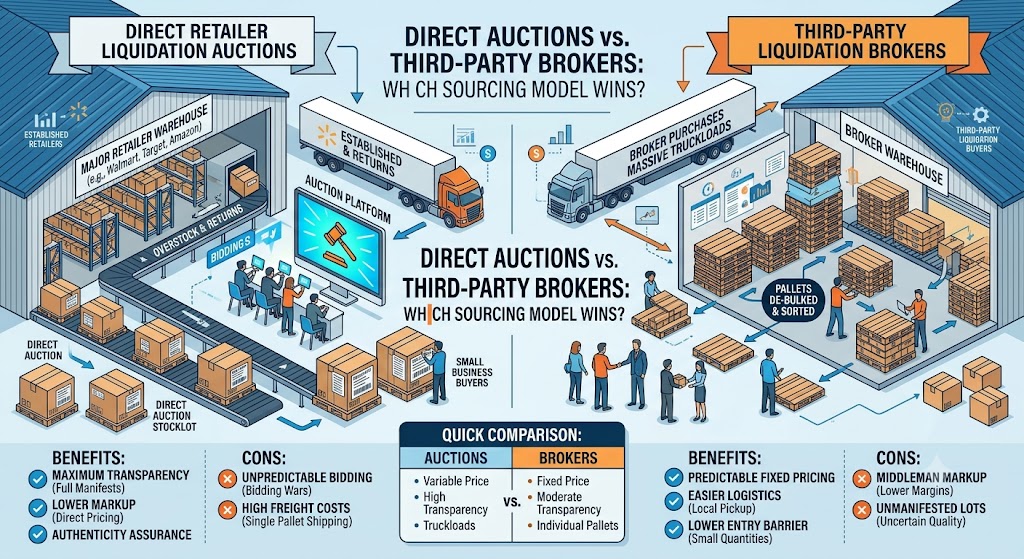
Direct liquidation auctions connect buyers straight to the source. Major retailers—such as Walmart, Target, and Amazon—host dedicated online storefronts to auction off excess merchandise directly to small businesses and resellers.
Key Benefits
-
Maximum Transparency: Retailers usually provide detailed manifest lists that outline the item descriptions, quantities, and original retail prices.
-
Lower Markup: You cut out middleman fees, which keeps your per-unit costs closer to raw liquidation rates.
-
Authenticity Guarantees: Sourcing directly eliminates the risk of receiving fraudulent or tampered pallets.
Potential Drawbacks
-
Unpredictable Bidding: Bidding wars can easily push pallet prices beyond your target profit margin.
-
Buyer’s Premiums & Freight Costs: Auction sites often charge standard buyer fees, and shipping a single pallet directly from a major warehouse can carry high freight costs.
Third-Party Liquidation Brokers
Third-party brokers act as intermediaries. They purchase massive truckloads or whole warehouses of inventory directly from retailers, divide the goods into smaller lots, and resell them to buyers at fixed prices.
Key Benefits
-
Predictable Fixed Pricing: Brokers generally sell at set prices, so you avoid the stress and uncertainty of timed auction bids.
-
Easier Logistics: Many local or regional brokers allow local warehouse pickups, saving you thousands on long-distance freight charges.
-
Lower Entry Barriers: Brokers frequently sell individual pallets, making them ideal for smaller operations or beginners who cannot buy full truckloads.
Potential Drawbacks
-
Built-in Middleman Markup: Brokers mark up the inventory to secure their own profit margins, which lowers your potential earnings.
-
Unmanifested Lots: Some brokers sell “cherry-picked” or unmanifested pallets, increasing the risk of getting lower-value goods.
Direct Auctions vs. Brokers: A Quick Comparison
| Feature | Direct Retailer Auctions | Third-Party Brokers |
| Pricing Model | Variable / Competitive Bidding | Mostly Fixed Price |
| Sourcing Transparency | High (Detailed Manifests) | Moderate to Low (Varies by Broker) |
| Shipping Costs | High (Freight rates depend on origin) | Flexible (Local pickup often available) |
| Best For | Experienced sellers & truckload buyers | Beginners & smaller-budget resellers |
Which One Should You Choose?
Your ultimate choice depends on your business size, risk tolerance, and available cash flow:
Choose direct retailer liquidation auctions if you have capital for truckloads, understand freight logistics, and want direct access to top-tier retailer inventory.
Choose third-party brokers if you prefer consistent, fixed pricing without bidding stress, want smaller inventory quantities, or wish to cut shipping costs through local warehouse pickups.
Many successful resellers combine both strategies—using brokers for quick, steady inventory and leveraging direct auctions when scaling up
